What Is Play-Based Learning?
Play-based learning is an approach to early education in which children build knowledge, skills, and understanding through self-directed, hands-on exploration, rather than through instruction alone.
It is not the absence of structure. A well-prepared play environment is deliberately designed the materials, the space, and the rhythm of the day are all chosen with care. What changes is the child's role. Instead of receiving information, the child investigates it. Instead of being told an answer, the child is given the conditions to discover one.
This is close to what Maria Montessori called "auto-education" a child's inbuilt drive to construct their own understanding when given the right environment and enough freedom within it. It is also close to what Krishnamurti meant when he spoke of learning as observation without authority: a child watching, questioning, and forming their own relationship with what is real, rather than simply absorbing what an adult declares to be true.
Why ELC Uses Play-Based Learning
Our approach doesn't rest on a single idea of what children need. It rests on three:
- Montessori , which gives us the discipline: a prepared environment, purposeful materials, and the patience to let a child repeat an activity until they have truly understood it, not just completed it.
- Krishnamurti's philosophy , which gives us the depth: the understanding that a child who is taught to observe and question freely will develop insight, not just information.
- A scientific outlook , which keeps us honest: we look at what the evidence on early childhood development actually shows, rather than relying on tradition or convenience.
Play sits exactly at the intersection of these three. It is disciplined (a child concentrating deeply on pouring rice from one container to another is doing real cognitive work). It is inquiry-led (a child asking "why does the tower keep falling?" is doing science, whether or not anyone calls it that). And it is, simply, how a young child is built to learn.
What Play-Based Learning Looks Like at ELC
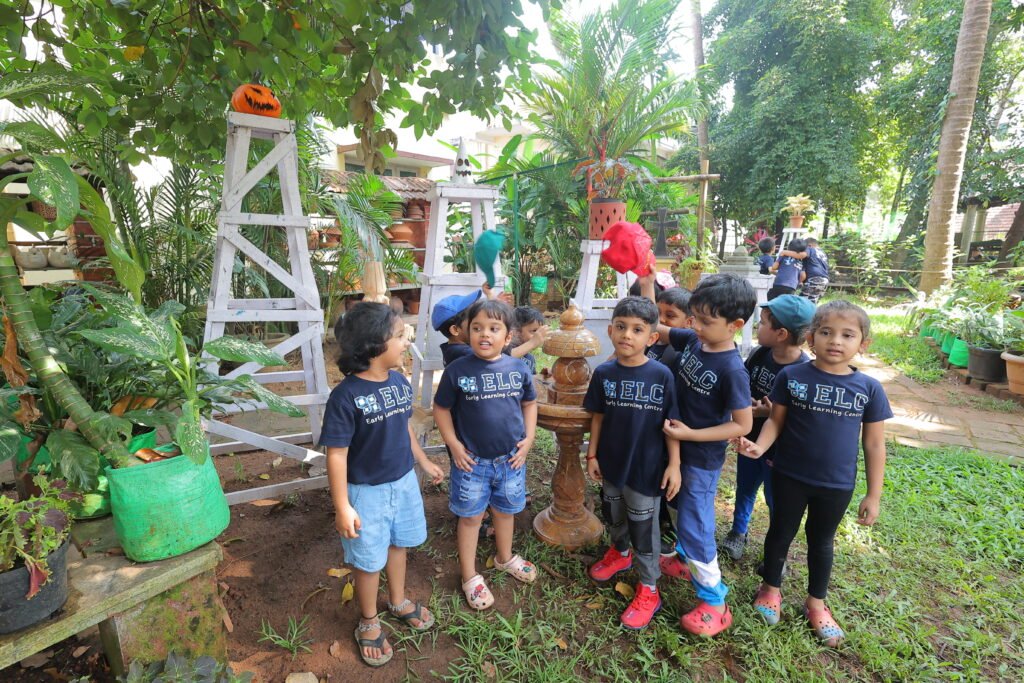
At ELC, play-based learning is woven into the everyday experiences of children. Instead of separating learning from play, we create opportunities for children to explore, experiment, create and make connections through meaningful activities
.A simple activity can lead to many different kinds of learning. Building with blocks can introduce children to balance, shapes, numbers and problem-solving. Pretend play can strengthen language, imagination and social skills, while art, music and movement encourage creativity and self-expression.
Children are also encouraged to make choices, ask questions and work things out independently. Teachers observe their interests and guide their learning with thoughtful questions, materials and experiences rather than simply providing answers.
This means that play at ELC is purposeful without feeling forced. Children are actively involved in discovering how things work, communicating their ideas, solving problems and learning from one another.
In play-based learning, the activity may look like play but underneath it, children are building skills, confidence, curiosity and a deeper understanding of the world around them.
The Real Benefits of Play-Based Learning
1. Cognitive Development
When a child decides how to balance uneven blocks or sort objects by their own invented rule, they are practising problem-solving, sequencing, and logical thought skills far more durable than anything memorised by rote.
2. Language and Communication
Play is often the first place children use language for a genuine purpose: negotiating a turn, narrating a story to themselves, describing what they've built. Vocabulary grows fastest when it's needed, not when it's drilled.
3. Social and Emotional Growth
Sharing a limited set of blocks, waiting a turn, managing frustration when a tower collapses these small daily frictions are where a child practises empathy, patience, and self-regulation. There is no worksheet for this. There is only practice, and play offers endless practice.
4. Physical Development
Pouring, threading, climbing, running, balancing, play-based activity quietly builds both the fine motor control needed for later writing and the gross motor strength needed for a confident, capable body.
5. A Genuine Love of Learning
Perhaps the least measurable, most important benefit: a child who is trusted to explore, question, and follow their own curiosity comes to associate learning with satisfaction rather than pressure. That disposition the love of learning itself is one of ELC's four pillars, and it is very hard to teach any other way.
Playgroup (below 2 years)
For the youngest children, play is sensory and relational their first experience of the world beyond home. Learning here looks like exploring textures, sounds, and simple cause-and-effect, always within a safe, observant environment that builds trust before it builds skills.
Kindergarten (3–6 years)
This is the heart of play-based learning at ELC a mixed-age environment where children move, explore, converse, and choose their own work. A child may spend twenty unhurried minutes with the pink tower, or sit with a friend sorting leaves collected that morning. Teachers observe closely, stepping in not to correct, but to extend: a well-placed question, a new material, a moment of quiet encouragement.
Primary and Middle School (6–13 years)
As children grow, play doesn't disappear it matures into structured inquiry, scientific investigation, and collaborative projects. The foundational habits built through early play curiosity, persistence, the comfort of not knowing an answer immediately become the tools older children use to reason, question, and form opinions of their own.
| Aspect | Play-Based Learning | Traditional Instruction |
|---|---|---|
| Starting point | The child's own curiosity | A fixed syllabus |
| Teacher's role | Observer and guide | Deliverer of information |
| Pace | Individual: a child stays with a concept as long as they need | Uniform: the class moves together |
| Evidence of learning | Observed understanding, repeated engagement, applied skill | Test scores and recall |
| Emotional tone | Intrinsic motivation, low pressure | Often extrinsic motivation, higher pressure |
Neither approach is without effort good play-based learning is, if anything, harder to design and harder to observe well. But the child at the centre of it experiences learning as something they are doing, not something being done to them.
Common Parent Questions About Play-Based Learning
Will my child fall behind academically?
Research and long-term observation consistently show the opposite: children who build strong foundational skills attention, self-regulation, problem-solving, language through play tend to adapt to formal academics with more confidence, not less, once those skills are asked to transfer.
How do you know a child is actually learning, if there are no worksheets?
Trained observation. Teachers at ELC watch closely which materials a child returns to, how long they concentrate, how their questions evolve and this observation, not a test score, is what tells us a child is progressing.
Isn't some structure necessary?
Yes and it’s there. The environment, the materials, and the teacher’s guidance are all carefully structured. What’s freed up is the child’s choice within that structure, which is precisely what makes the learning theirs.
A Closing Thought
Carl Sagan once wrote that young children are natural-born scientists curious, unafraid of the wrong answer, and full of questions no one has told them to consider "dumb." Play-based learning doesn't create that quality in a child. It simply refuses to take it away.
At ELC, that's the quiet promise behind every block tower, every muddy handful of leaves, and every "why" we choose to answer with another question: learning that trusts the child.

[…] learning and play-based learning aren’t separate philosophies competing for space in the same classroom — they’re […]