Curiosity and independent learning in young children
are important parts of early childhood development. Young children naturally want to discover how things work, ask questions, explore new objects, and understand the world around them. When adults provide a supportive environment, these natural interests can become meaningful learning experiences.
A child who asks why the sky changes colour, a child who tries different ways to build a tower, or a child who chooses a book and explores it independently is already developing important learning skills.
Early childhood is therefore an important stage for building confidence, curiosity, problem-solving abilities, and independence.
For parents and educators looking for information about early childhood learning, ELC India offers resources related to early learning and child development.
Why Curiosity Matters in Early Childhood
Curiosity encourages children to observe their surroundings, ask questions, and look for answers. Children often learn because something catches their attention and makes them want to know more.
Encouraging curiosity in children can begin with simple everyday experiences. A walk outside, playing with blocks, looking at plants, watching insects, reading a story, or playing with water can all create opportunities for discovery.
Instead of immediately giving children an answer, adults can encourage them to think.
For example, if a child asks, “Why did the leaf fall?” an adult could ask, “What do you think happened?”
This gives the child an opportunity to observe, think about possible explanations, and share an idea.
Curiosity can also encourage children to continue exploring when they encounter something unfamiliar. When children feel that their questions are valued, they become more comfortable asking questions and expressing their ideas.
What Is Independent Learning for Young Children?
Independent learning for young children means giving children appropriate opportunities to make choices, attempt tasks, explore materials, solve simple problems, and take an active role in learning.
It does not mean leaving children without adult support. Young children still need guidance, boundaries, encouragement, and supervision.
For example, an adult can provide two suitable activities and allow the child to choose one. A teacher might provide different construction materials and let children decide what they want to build.
These small choices help children practise decision-making.
Independent learning develops gradually. Younger children may need more assistance, while older preschool children may be able to complete more steps independently.
The goal is to provide children with enough support while still allowing them to participate actively.
7 Ways to Encourage Curiosity and Independent Learning
-
1. Ask Open-Ended Questions
Questions are one of the easiest ways of encouraging curiosity in children.
Instead of asking questions that require only “yes” or “no,” adults can ask:
- “What do you notice?”
- “What do you think will happen?”
- “Why do you think that happened?”
- “How could we find out?”
- “What could we try next?”
- “How could you make it different?”
For example, when a child builds a tower with blocks, instead of telling the child how to make it stronger, ask, “What could we change so the tower does not fall?”
The child can then experiment with different arrangements.
Open-ended questions encourage children to express their own ideas instead of simply repeating information given by adults.
-
2. Give Children Meaningful Choices
Giving children appropriate choices is an important part of independent learning for young children.
Parents and educators can offer two or three suitable options.
For example:
“Would you like to read a book or build with blocks?”
“Would you like to draw or paint?”
“Would you like to play outside or complete a puzzle?”
Simple choices help children practise decision-making without giving them too many options.
As children become more confident, adults can gradually provide more opportunities for them to plan activities and make decisions.
-
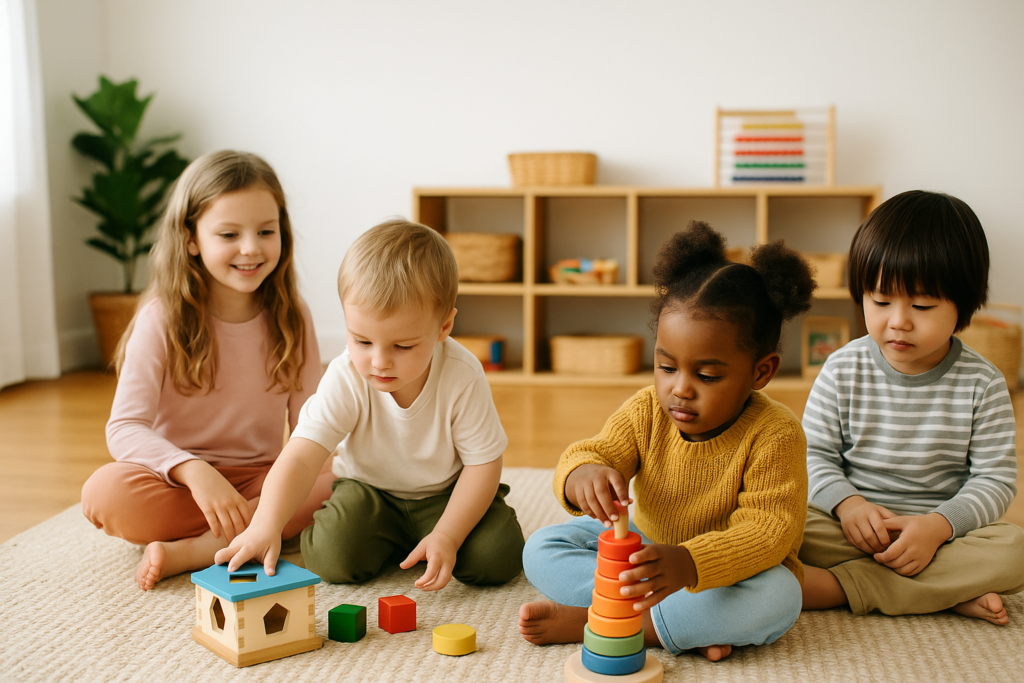
3. Encourage Play-Based Learning
Play-based learning allows children to learn while participating in enjoyable and meaningful activities.
Blocks, puzzles, pretend play, drawing, clay, water, sand, music, and outdoor activities can all support learning.
For example, children building with blocks may explore balance, shape, size, height, and structure. During pretend play, children may develop language, imagination, communication, and problem-solving skills.
Play also allows children to repeat activities and test different ideas.
Adults do not always need to direct the activity. Sometimes, observing children’s play and asking an occasional question can help extend their thinking.
-
4. Provide Open-Ended Materials
Children can become more independent when they have access to materials that can be used in different ways.
Examples include:
- Blocks
- Cardboard boxes
- Paper
- Clay
- Fabric
- Containers
- Natural objects
- Drawing materials
A cardboard box can become a house, vehicle, shop, robot, or anything else the child imagines.
There is no single correct way to use these materials.
This gives children opportunities to decide what they want to create and how they want to create it.
Open-ended materials can support creativity, decision-making, problem-solving, and confidence.
-
5. Give Children Time to Try
Adults often want to help children immediately when they experience difficulty. However, allowing children some time to try independently can create valuable learning opportunities.
If a child is struggling with a puzzle, building activity, or simple task, avoid immediately completing it.
Instead, try asking:
“Would you like to try another way?”
“What do you think you could do next?”
“Would you like a small hint?”
This gives children support without removing their opportunity to solve the problem.
Children gradually learn that challenges can be approached through patience and different strategies.
-
6. Encourage Learning Through Exploration
-
7. Help Children Learn From Mistakes
- Leaves and plants
- Water and ice
- Sand and soil
- Blocks and construction materials
- Shadows and light
- Natural objects
- Household materials
- Books and pictures
Learning through exploration allows children to discover ideas through direct experiences.
Exploration can happen indoors or outdoors.
During a nature walk, children can observe leaves, flowers, insects, birds, stones, and clouds. At home, children can explore what happens when ice melts or when different objects are placed in water.
Children can also observe how shadows change or how plants grow over time.
Adults can encourage exploration with questions such as:
“What do you notice?”
“What is different?”
“What do you think will happen?”
“What could we try?”
The objective is not always to find the correct answer immediately. The process of observing, testing, and discovering is itself an important learning experience.
Mistakes are a natural part of learning.
If a child’s block tower falls, the experience can become an opportunity to try a different design. If a child’s paper creation does not work as expected, the child can experiment with another approach.
Instead of saying, “That’s wrong,” adults can ask:
“What happened?”
“What could we change?”
“Would you like to try again?”
This approach helps children understand that mistakes can provide useful information.
When children are encouraged to try again, they can gradually develop persistence and confidence.
How Parents Can Support Independent Learning
Parents can encourage independent learning for young children through everyday activities.
Children can help put away toys, select a book, water plants, organize simple materials, choose between suitable clothes, or help prepare food with appropriate supervision.
Parents can also create a small learning space with books, puzzles, blocks, drawing materials, and other safe resources.
When children know where their materials are kept, they can begin choosing activities without always waiting for an adult.
However, independence should develop according to the child’s age and abilities.
Creating a Curious Classroom
Teachers can create classrooms where children feel comfortable asking questions and exploring ideas.
For example, if children become interested in insects after finding one outdoors, teachers can provide books, pictures, drawing materials, and safe opportunities to observe insects.
If children become interested in building, teachers can provide blocks, boxes, and construction materials and encourage them to create different structures.
This approach makes children’s interests part of the learning experience.
A classroom that welcomes questions can help children become more active participants in learning.
The Role of Play-Based Learning
Play-based learning can connect children’s natural interests with important developmental skills.
During construction play, children may develop problem-solving and spatial awareness. During pretend play, they can practise communication and social interaction. During art activities, they can make choices and express ideas.
Play also allows children to learn at their own pace.
Adults can support play by providing interesting materials, asking thoughtful questions, and giving children enough time to explore. gives young children opportunities to explore, make choices, express ideas, and develop important skills through meaningful experiences. UNICEF India highlights learning through play as an important part of early childhood education and school readiness. For more information, read the UNICEF India guide to Early Childhood Education
For more information about early childhood education and learning approaches, visit ELC India.
Building Confidence Through Everyday Experiences
Small achievements can help children become more confident.
When a child completes a puzzle, chooses an activity, builds something, organizes toys, or solves a simple problem, adults can recognize the effort.
Instead of focusing only on the final result, adults can say:
“You kept trying.”
“You found another way.”
“You chose the materials yourself.”
“You thought carefully about that.”
These comments help children understand that effort, persistence, and thinking are valuable.
Creating Opportunities for Learning Through Exploration
Learning through exploration does not require expensive educational equipment.
Everyday objects and environments can provide opportunities for discovery.
Children can explore:
Adults can encourage children to observe what changes, compare objects, and explain what they notice.
For example, children can collect different leaves and compare their colours, sizes, shapes, and textures.
This simple activity can encourage observation, vocabulary, comparison, and questioning.
Balancing Support and Independence
Encouraging independence does not mean that adults should never help children.
Young children need adults to provide guidance, establish boundaries, introduce new ideas, and maintain safety.
The important part is finding a balance.
If an adult does everything for the child, there may be fewer opportunities for independent thinking. If the adult provides no support, the child may become frustrated.
A balanced approach allows children to attempt tasks while knowing that an adult is available when support is needed.
Conclusion
Curiosity and independent learning in young children can be encouraged through simple experiences at home and in early learning environments.
Encouraging curiosity in children begins with listening to their questions, asking open-ended questions, and giving them opportunities to investigate their surroundings.
Independent learning for young children develops when children are allowed to make suitable choices, attempt tasks, solve problems, and learn from their experiences.
Play-based learning provides an enjoyable environment where children can develop creativity, communication, problem-solving, and decision-making skills.
At the same time, learning through exploration allows children to discover ideas by observing, experimenting, comparing, and asking questions.
Parents and educators do not need complicated activities to support these skills. Everyday experiences can become meaningful learning opportunities when children are given time, encouragement, appropriate choices, and a safe environment.
For more information about early childhood education and learning, visit ELC India.